- All
- Product Name
- Product Keyword
- Product Model
- Product Summary
- Product Description
- Multi Field Search


Views: 0 Author: Site Editor Publish Time: 2026-06-25 Origin: Site


Specifying the wrong single-phase motor carries high stakes. Original equipment manufacturers and facility managers know this well. A poor choice often leads to premature capacitor failure. It causes excessive thermal loads. You might even experience stalling under heavy starting torque. We must look at the baseline reality. YL and YCL lines both serve standard single-phase power setups. However, their internal capacitor configurations are fundamentally different. These differences completely alter their efficiency and torque profiles. They dictate which specific machinery they fit best. This article provides an objective, spec-driven framework. We will help you choose between YL and YCL/YC series motors. You will learn to evaluate load characteristics and operating costs. We also cover practical implementation realities. By the end, you will confidently match motor specifications directly to your mechanical demands.
YL Series: Utilizes a dual-capacitor (start and run) design, prioritizing high running efficiency, better power factor, and lower noise for continuous-duty machinery.
YCL/YC Series: Functions primarily as a heavy-duty capacitor start single phase motor, delivering maximum starting torque for high-inertia loads like compressors and crushers.
Cost vs. Lifecycle: YCL motors generally offer a more rugged, cast-iron build for harsh environments, while YL motors provide long-term energy savings in standard commercial or home use single phase motor applications.
Implementation Rule: Match the motor not just to the required HP, but to the specific starting inertia and duty cycle of the small machinery.
Engineers often look straight at horsepower. You need more than just raw power for reliable operations. The primary metric for motor selection involves a crucial ratio. You must compare starting torque to running efficiency. We establish this ratio as your absolute success criteria. Ignoring it leads to equipment failure.
Different machines demand different energy profiles during startup. You must classify your equipment accurately.
High-Inertia (Hard to start): Think of air compressors and hydraulic pumps. Heavy material mixers fit here too. They require massive initial energy spikes to break static friction. These loads fight against backpressure immediately.
Low/Medium-Inertia (Easier to start, continuous run): Blowers and small agricultural fans are easier to start. Drill presses and light conveyors also fall into this category. They need less initial punch. They simply gather speed smoothly.
Your duty cycle dictates the required capacitor design. Intermittent starting stresses a motor differently than continuous operation. Rapid stop-and-start cycles generate massive heat spikes inside the windings. Continuous 24/7 operation demands excellent heat dissipation. You must choose a capacitor design capable of surviving the specific thermal threshold of your application.
Common Mistake: Buying a high-torque motor for a low-inertia fan. You will waste electricity continuously because the running efficiency drops significantly.
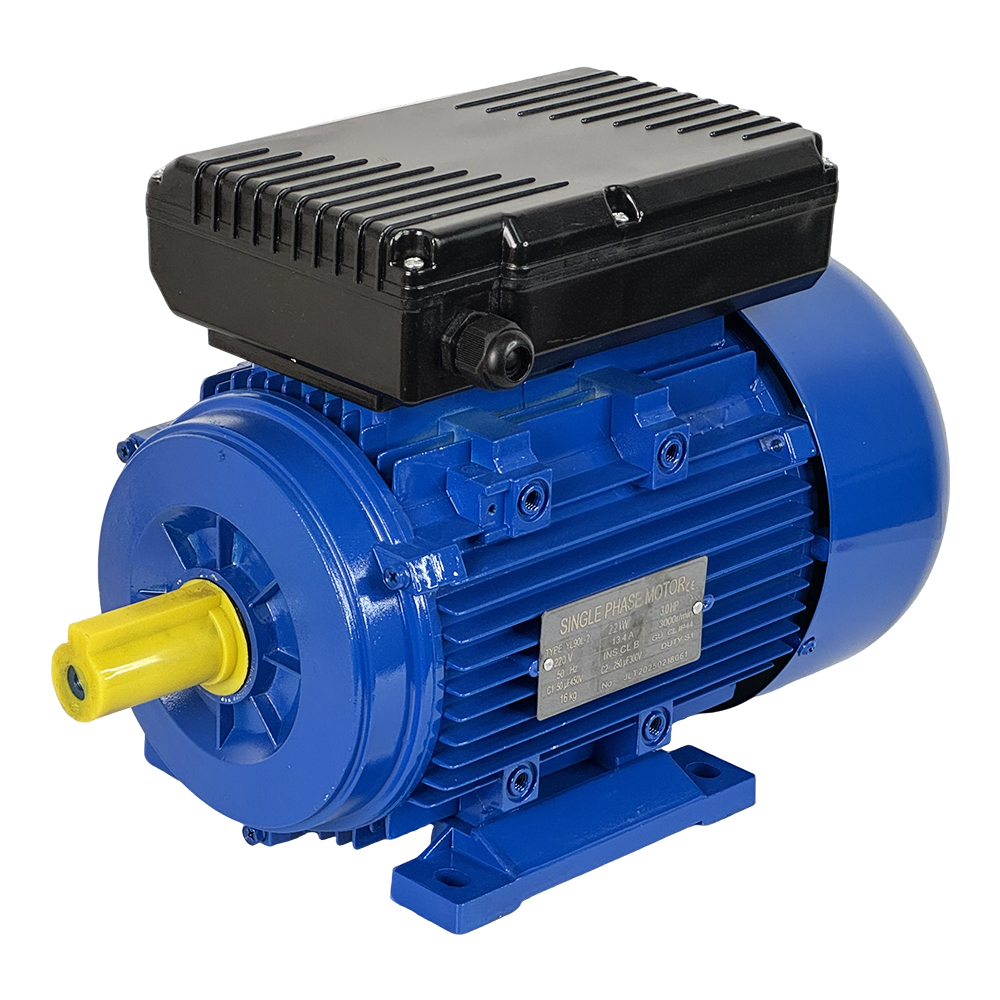
The YL Single Phase Motor uses an advanced dual-capacitor configuration. One capacitor provides the initial starting torque. A secondary capacitor stays engaged permanently. It optimizes the running phase by shifting the electrical phase angle closer to 90 degrees. This creates a much smoother rotating magnetic field.
This technical framework changes how the motor performs over long shifts. You get a higher power factor. Overall running efficiency improves noticeably compared to single-capacitor designs. The motor operates very smoothly. You will notice lower vibration levels. It also reduces acoustic noise significantly.
We highly recommend it as a small equipment ac motor. It handles steady, continuous operation perfectly. Use it for water pumps and agricultural ventilation systems. Specialized home workshop machinery also benefits from this quiet, efficient design.
The run capacitor adds a point of potential failure. It remains active in the circuit constantly. It can degrade quickly if subjected to severe voltage fluctuations. Extreme ambient heat also damages it over time. Facility managers must ensure adequate ventilation around the motor housing.
We must look closely at the pure capacitor start single phase motor. The YC single phase motor and its modernized YCL variant define this category. They rely heavily on a mechanical centrifugal switch. This switch disengages the start capacitor once the shaft reaches about 75% of its operational speed. It leaves only the main winding active.
The performance outcomes focus entirely on raw power. You get exceptional starting torque. It often delivers 2.5 to 3 times the rated full-load torque. The physical construction is extremely robust. Manufacturers frequently use cast iron for the housing. This heavy shell absorbs high-vibration impacts easily.
These motors dominate harsh, demanding environments. Heavy-duty agricultural equipment relies on them. Commercial meat grinders and industrial air compressors need this power. Woodworking machinery prone to jamming requires this extra push to clear blockages.
You accept lower running efficiency. The power factor drops compared to the YL series. The motor also carries a heavier physical footprint. It costs more to run continuously over a 24-hour period.
Best Practice: Always inspect the centrifugal switch annually. Dust buildup can cause the switch to stick, leading to rapid capacitor burnout.
You must weigh several engineering dimensions before making a final procurement decision.
Compare the torque curves carefully. The YCL dominates the first three seconds of operation. It rips through static friction effortlessly. The YL dominates the next eight hours of running. It sips electricity and stays cool. You must decide which phase matters more for your specific machine.
Analyze standard motor enclosures. The YCL typically defaults to heavier cast iron. Iron provides better thermal mass for severe starts. It absorbs heat spikes without melting the insulation. The YL often uses aluminum housings. Aluminum dissipates steady heat much faster during continuous running. Check your required IP ratings. Dusty environments demand IP54 or IP55 protection.
Calculate the long-term cost impact. The YL’s run capacitor improves the power factor significantly. Utilities often penalize low power factors in commercial settings. The YL makes it cheaper to run continuously over long shifts.
Evaluate the reliability of internal components. The YCL relies on mechanical centrifugal switches. These switches can stick or fail due to physical wear. The YL avoids switch cycling entirely. However, it faces run capacitor degradation over years of service.
Specification Dimension | YL Series (Dual-Capacitor) | YCL/YC Series (Capacitor-Start) |
|---|---|---|
Starting Torque | Moderate (1.5x to 2x rated) | Exceptional (2.5x to 3x rated) |
Running Efficiency | High (Optimized phase angle) | Moderate (Main winding only) |
Primary Housing Material | Aluminum (Excellent heat dissipation) | Cast Iron (High thermal mass) |
Acoustic Noise | Low (Smooth magnetic field) | Higher (Vibration prone) |
Maintenance Vulnerability | Run capacitor degradation | Centrifugal switch sticking |
Procurement looks good on paper. Implementation exposes real-world flaws. You must address facility constraints directly.
Address the risk of voltage drops in rural or residential grids. A heavy YCL motor start draws massive inrush current. It might trip breakers in standard home use single phase motor setups. The electrical panel simply cannot handle the spike. The YL provides a slightly smoother power draw during startup.
YCL motors weigh significantly more. They often require reinforced mounting plates on small machinery. Lighter YL units install much easier. They place less physical stress on sheet metal frames.
Engineers often make two critical errors. Do not oversize a YL motor just to compensate for starting torque. A larger motor running below its rated load tanks the power factor. This wastes money. Do not undersize a YCL motor for a continuous application. The main winding will overheat. This wastes energy and destroys the insulation.
Follow these steps strictly before issuing purchase orders:
Identify the start condition: If the machine starts under a heavy load, specify the YCL series immediately.
Identify the run condition: If the machine runs constantly and starts unloaded, specify the YL series.
Check the environment: Verify the required IP rating for dust and water ingress.
Measure the space: Ensure the frame size and weight match your mounting plate limits.
Neither motor is inherently superior. Their true value is strictly tied to load matching. Prioritizing the YL series yields massive energy efficiency for continuous loads. It keeps noise down and runs cool. Conversely, the YCL/YC series brings necessary brute force. It effortlessly handles hard-starting equipment and severe impacts.
We strongly encourage engineers and buyers to audit their machinery closely. Map your exact duty cycles. Measure your starting torque requirements precisely. Choose the motor that fits your mechanical reality, and you will eliminate premature failures.
A: You can only do this if the starting load is extremely low. High-inertia loads require massive initial torque. The YL provides moderate starting torque. If you install it on a heavy compressor, it may stall. This stalling draws locked-rotor current and quickly burns out the windings.
A: Several factors destroy capacitors. Severe voltage spikes puncture the internal dielectric material. Excessive ambient heat dries out the chemical electrolyte. Cycling the motor on and off too rapidly also causes massive thermal stress. Proper ventilation and stable voltage extend capacitor life.
A: The YL series is generally preferred for home workshops. It produces less acoustic noise and less vibration. It also draws a lower starting current. This prevents tripping standard residential circuit breakers. However, if you run a large air compressor, you still need a YC motor.
A: Yes, both typically use a mechanical centrifugal switch. The switch disengages the start capacitor once the motor reaches 75% of operational speed. The key difference lies afterward. The YCL runs only on its main winding. The YL retains a secondary run capacitor in the active circuit.


