- All
- Product Name
- Product Keyword
- Product Model
- Product Summary
- Product Description
- Multi Field Search


Views: 0 Author: Site Editor Publish Time: 2026-06-12 Origin: Site


Specifying motors for volatile environments is a high-stakes balancing act between stringent safety compliance and capital expenditure. You face intense pressure from multiple departments to get this specification exactly right. Misclassifying a hazardous location electric motor leads to fatal safety vulnerabilities if you under-specify the unit. Conversely, over-specifying creates an unnecessary and massive budget drain. You simply cannot afford either mistake in today’s highly regulated industrial landscape.
This guide provides a systematic, evidence-based evaluation framework. We help facility managers and procurement engineers match motor specifications to actual operational realities. You will learn how to navigate complex compliance standards seamlessly. We ensure you maintain rigorous safety protocols without sacrificing operational efficiency. Read on to master the essential steps for selecting the perfect motor for your specific hazardous environment.
Selection must begin with an exact mapping of the facility’s hazard classification (NEC/CEC Class/Division vs. ATEX/IECEx Zones) prior to evaluating motor performance.
Temperature codes (T-Codes) are the most critical, yet frequently misunderstood, specification—the motor’s maximum surface temperature must remain below the ignition threshold of the specific environmental combustible.
Running an explosion proof motor on a Variable Frequency Drive (VFD) requires specific "inverter-duty" certifications due to the risk of overheating at low speeds.
Your selection process must always start with the environment. You cannot pick a motor without knowing the exact regulatory and physical conditions of your facility. We recommend following a structured mapping approach to ensure absolute compliance.
Determine whether your facility operates under North American standards or international frameworks. North America uses the National Electrical Code (NEC) and the Canadian Electrical Code (CEC). These standards rely strictly on a Class and Division system. International facilities follow ATEX or IECEx standards. These frameworks utilize a distinct Zone-based system. Your baseline dictates every subsequent specification decision.
Compliance Framework Comparison | |||
Region | Standard | Classification Method | Primary Application Focus |
|---|---|---|---|
North America | NEC / CEC | Classes and Divisions | Domestic Oil, Gas, and Heavy Industrial |
Global / Europe | ATEX / IECEx | Zones | International Projects, Global Shipping |
You must identify the specific hazardous material present in your facility. The NEC framework categorizes these into three primary classes.
Class I: These environments contain flammable gases, vapors, or liquids. Petrochemical plants, offshore oil rigs, and chemical refineries fall into this category.
Class II: These locations contain combustible dusts. Grain handling facilities require specific dust exclusion designs. You will also frequently see this classification when specifying a mining explosion proof motor for underground coal applications.
Class III: These areas feature ignitable fibers and flyings. Textile mills, paper processing plants, and woodworking shops typify Class III environments.
Next, determine how often the hazard actually exists in the atmosphere.
Division 1 / Zone 0 & 1: The hazard is present during normal, everyday operations. These areas require maximum structural containment. For example, you need a highly robust flameproof ac motor here to handle continuous explosive risks.
Division 2 / Zone 2: The hazard is only present during abnormal conditions. Spills, leaks, or mechanical exhaust failures trigger the danger. Normal daily operations remain entirely safe and vapor-free.
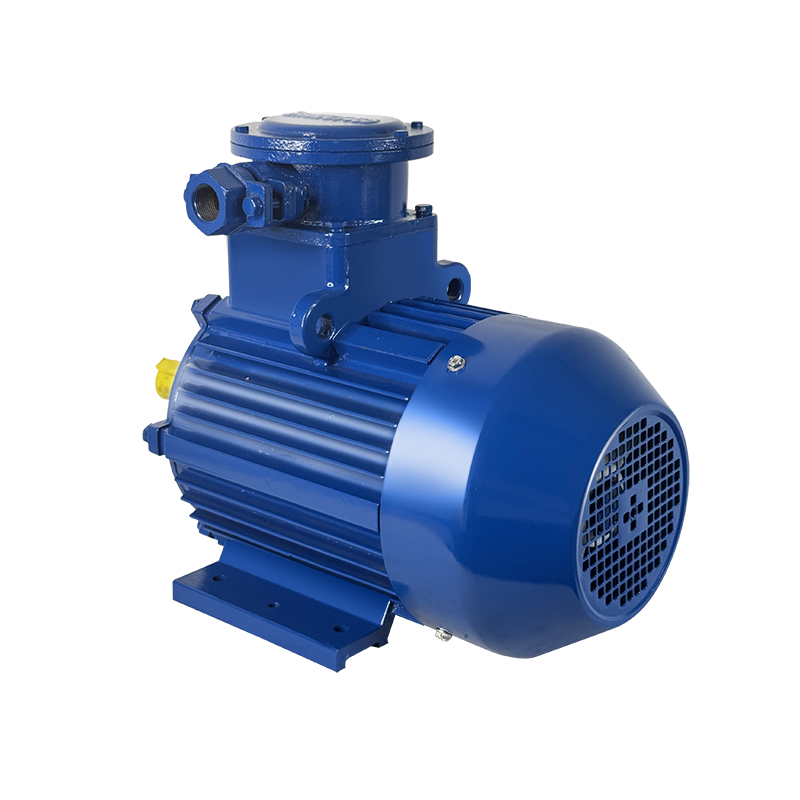
Reading a hazardous location nameplate requires deep technical precision. You must accurately translate the operational environment into specific engineering ratings. Failing to verify the nameplate data against facility documentation is a common and dangerous mistake.
Match the motor to the specific chemical properties of your environment. You cannot treat all gases or dusts identically.
Gas Groups (A, B, C, D): Different gases produce drastically different explosion pressures. Acetylene (Group A) generates extreme pressure and requires a much thicker motor construction than Propane (Group D).
Dust Groups (E, F, G): Dusts behave differently based on their electrical conductivity. Metal dusts (Group E) pose different short-circuit risks than carbon or coal dusts (Group F). Grain dust (Group G) requires unique bearing sealing strategies to prevent friction fires.
T-Codes represent critical safety metrics. You must understand the absolute rule: The motor's T-Code rating represents its maximum operating surface temperature under worst-case fault conditions. This includes locked rotor scenarios or heavy voltage drops.
Your decision criteria must remain incredibly strict. The T-Code temperature must always remain lower than the Auto-Ignition Temperature (AIT) of the specific gas or dust in the environment. If your motor runs at 200°C in an environment where dust ignites at 180°C, you risk a catastrophic facility explosion.
Common T-Code Classifications and Limits | ||
T-Code | Maximum Surface Temperature | Typical Application Scenario |
|---|---|---|
T1 | 450°C (842°F) | High AIT gases like Methane or Hydrogen |
T3 | 200°C (392°F) | General industrial chemical vapors |
T4 | 135°C (275°F) | Low AIT environments (common in petrochemicals) |
T6 | 85°C (185°F) | Highly volatile dusts and carbon disulfide |
Evaluate your environmental exposure carefully. If you routinely wash down equipment with high-pressure hoses, you need high ingress protection. Outdoor weather conditions also demand strong sealing. Standard indoor hazardous areas might only need an IP55 rating. Heavy washdowns or severe offshore weather exposure require IP66 ratings to prevent moisture from degrading internal windings.
You must bridge the gap between compliance documentation and actual mechanical performance. A highly compliant motor is completely useless if it fails under load. You must evaluate the electrical powertrain holistically.
Many modern facilities use VFDs to improve energy efficiency. However, you must proactively address the hidden thermal risks. Standard motors rely entirely on shaft-mounted fans for cooling. When VFDs lower the motor's RPM, cooling capacity drops drastically. The motor still generates internal heat, causing hazardous temperature spikes.
Actionable step: Ensure you explicitly specify an "Inverter Duty" rating. Your chosen Explosion Proof Motor must feature a certified constant torque speed range. You should also demand integrated thermistor protection. Thermistors monitor internal heat proactively and will shut down the drive before the external surface temperature breaches the T-Code limit.
Evaluate how the motor actually runs in the field. Will it run continuously, or will it endure short, heavy start-stop bursts? High-cycling applications generate significant excess heat. You must account for this heat in the hazardous rating. A standard 1.15 service factor might drop to 1.0 when paired with a VFD. We strongly recommend analyzing your peak load cycles with an electrical engineer before finalizing the thermal capacity.
Verify standard NEMA or IEC frame dimensions closely. You want seamless physical integration into your existing infrastructure. Avoid modifying mounting bases or drilling new holes at all costs. Uncertified mechanical modifications compromise the equipment's structural integrity. Always match the exact frame size to prevent dangerous shaft alignment issues, which cause premature bearing failure and excessive friction heat.
Many procurement engineers make costly assumptions during specification. You can avoid these financial and operational pitfalls by understanding key nuances in the electrical code.
Many people default to the highest protection level just to feel safe. Installing a Class I, Division 1 motor in a Division 2 environment is a frequent mistake. This drastically inflates your initial capital expenditure. It also complicates future routine maintenance unnecessarily, as Division 1 motors are heavier and harder to access.
Evaluate alternative protection methods for Division 2 areas. You can often use standard Totally Enclosed Fan Cooled (TEFC) motors equipped with specialized non-sparking features. These features include brass cooling fans and non-sparking terminal blocks. Always verify this approach with local electrical codes. If local codes permit it, you will save a substantial portion of your budget.
We must clarify important technical nuances regarding enclosure design. Many professionals fundamentally misunderstand how these enclosures actually work. An explosion-proof enclosure is not designed to keep explosive gases out. Instead, it is specifically engineered to allow gases in.
When an internal electrical spark ignites those internal gases, the rigid enclosure contains the resulting explosion. The precisely machined flame paths (often labyrinth or threaded joints) then rapidly cool the escaping exhaust gases. By the time those hot gases reach the external environment, they are safely below the external ignition threshold.
Standard motor nameplate ratings assume a maximum ambient temperature of 40°C (104°F). Many hazardous locations, like desert refineries or confined boiler rooms, routinely exceed this baseline. Operating in high-heat environments requires specialized derating calculations from the manufacturer. If you ignore ambient limits, your motor will overheat rapidly. This invalidates the safety rating immediately and puts your personnel at severe risk.
Your final step involves scrutinizing the supply chain. You must partner with vendors who understand hazardous industrial environments deeply. Do not base your final decision purely on upfront price.
Demand verifiable third-party testing certificates before issuing a purchase order. Look for documentation from globally recognized bodies like UL, CSA, Baseefa, or PTB. Self-certification is completely unacceptable for a hazardous location electric motor. If a vendor cannot produce independent, traceable test results, walk away immediately. You carry the ultimate legal liability if the equipment fails during an audit or an emergency.
Factor in the specialized physical construction of these units. These motors feature extremely heavy cast-iron construction to withstand internal explosion pressures. They utilize incredibly tight machining tolerances—often measured in microns—to create functional flame paths. These physical realities make initial installation, laser alignment, and eventual rewinding much more labor-intensive than standard motors.
Confirm vendor support for certified repair centers in your region. Routine maintenance requires highly specialized knowledge. If an unauthorized repair shop overhauls the unit, they might inadvertently alter the precise machining tolerances of the flame paths. Unauthorized physical modifications immediately void the explosion-proof safety rating.
Explosion-proof units often have significantly longer manufacturing lead times. They require specialized heavy castings and rigorous post-production testing protocols. Establish strong supply chain contingencies for mission-critical replacements. We recommend keeping essential, pre-certified spare units in your local inventory to prevent prolonged, costly facility downtime.
Selecting an explosion-proof motor is a rigorous exercise in precise environmental matching. Success relies on your strict adherence to proper T-Codes, operational area classifications, and verifiable vendor testing certifications. You must align complex electrical performance data with harsh mechanical realities.
Avoid the temptation to over-specify equipment out of fear, but never compromise on mandatory third-party testing. Gather your facility’s official hazard classification documentation today. Review the specific Gas and Dust groups present in your environment. Then, consult directly with certified application engineers to begin shortlisting exact motor models. Taking this systematic approach ensures you protect your workforce and optimize your capital budget simultaneously.
A: No. Standard TEFC enclosures are not structurally engineered to contain an internal explosion or cool escaping gases. Applying external sealants or heavy caulking does not change the structural cast integrity or create the necessary flame paths. This practice is entirely illegal and highly dangerous for any Class I/Div 1 or Class II environments.
A: Repairs, such as rewinding stators or replacing heavy bearings, must be performed by a certified hazardous-location repair facility. Altering the precise machining tolerances of the internal flame paths will immediately void the motor's safety rating. You must maintain strict certification continuity throughout the motor's entire operational lifecycle.
A: Yes. Mining environments typically require strict compliance with MSHA (Mine Safety and Health Administration) standards, focusing heavily on methane gas and coal dust containment. Conversely, surface petrochemical plants follow NEC or API standards focused on highly diverse industrial gas and chemical vapor groups.


